en


A tournament turns ordinary spins into a ranked contest. Instead of playing only against the maths of one slot, your qualifying bets also collect points on a board, and the top places share a prize pool. At DK88, short for DashKing88, two different kinds of tournament run side by side in the slots lobby, and they do not work the same way.
This page covers both of them: what a provider network campaign is, what a local DK88 tournament looks like, how entry works, how leaderboards are scored in general, and what to read in a tournament’s own rules before you press Participate.
The first kind is the provider network tournament. These are campaigns built and funded by a game studio, running across the sites that carry its slots. Pragmatic Play Drops & Wins is one of them, and Fugaso’s Book of Billionaire tournament is another. Because the campaign belongs to the studio rather than to any single casino, the field is large: in general, everyone playing the qualifying titles anywhere in the network is competing for the same pool.
Stated
Fugaso’s Book of Billionaire tournament carries an RM7,000,000 prize pool.
In practice
That figure belongs to the studio’s network campaign, so it is contested across every site running it, not only here. Where you finish on the campaign board decides your share, and the campaign rules state how and where a prize is credited.
The second kind is local. A local DK88 tournament is organised for our players only, for example around one studio’s slots over a set number of days. The field is smaller than a network campaign, the board is shorter, and the prizes are set by us rather than by the provider.
Both kinds sit in the lobby as cards you can open, read and enter. Drops & Wins at DK88 behaves like any other network campaign, while a local board starts and ends on our own schedule.
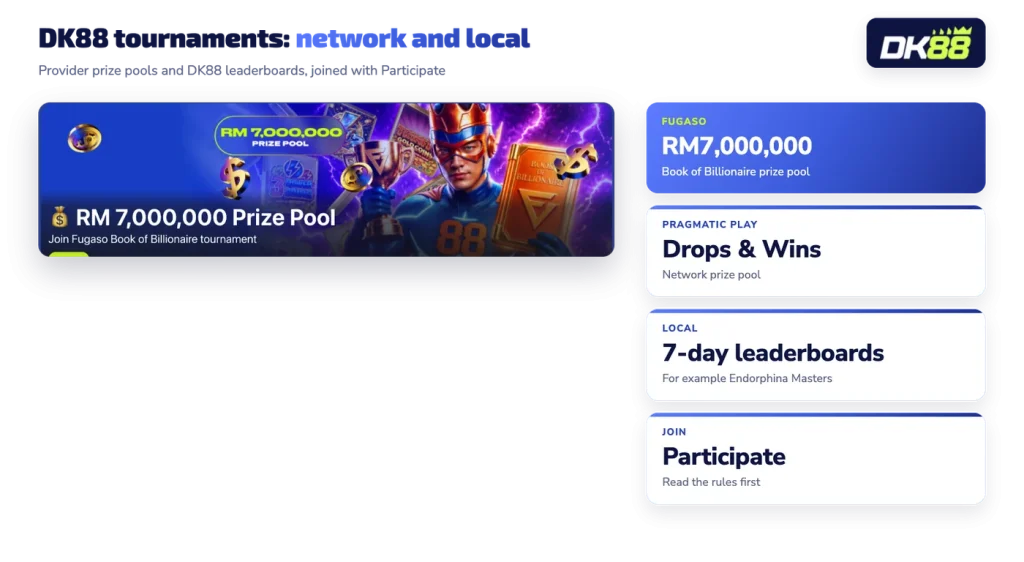
Endorphina Masters shows the shape of a local contest clearly. It is a 7-day slots leaderboard challenge built on Endorphina titles, so the whole week of qualifying play feeds one board.
At one moment during that challenge, the board was paying RM388 for first place, RM288 for second and RM188 for third. Treat those numbers as an example of how a local prize table is laid out, not as a standing offer: every local tournament publishes its own places and amounts on its own card, and they change from one event to the next.
A short board like this also changes how you should read your position. On a 7-day contest, a single strong session can move you several places, so checking the board before your last day of play tells you whether a prize place is still in reach.
Entry is deliberately simple, because the rules, not the entry, are the part that needs your attention.
You play with the same account and the same balance you use every day, so nothing has to be moved or converted to take part.
Tournaments, boards and prize pools all run from one DashKing88 account, with the slots you already play.
Scoring is set per tournament, but the underlying models are few. As a rule, a slot leaderboard uses one of two methods. The first counts points per qualifying bet, which rewards volume and steady play. The second counts win multipliers, so a single spin that returns many times its stake can lift you above a player who has spun far more often. Some campaigns combine the two, and prize drops may run alongside the board as random awards on qualifying spins.
Minimum bets exist for the same reason in every format. Without one, a board could be climbed with thousands of token spins, so a floor keeps the contest between comparable stakes. Tie rules matter as well: when two players finish level, campaigns commonly settle it by who reached the score first, and the rules say which applies.
The practical consequence is that the same bankroll performs differently in different formats. A bet-count board favours longer sessions at a modest stake, while a multiplier board can be won in a handful of spins on a volatile title.
Each tournament card answers the same set of questions. Read them in this order:
Before you continue
Read the tournament’s own rules for eligible games, minimum bet and which bets count before you press Participate. Those three lines decide whether your spins score at all.
| Tournament type | Who competes | Example | Where prizes come from |
|---|---|---|---|
| Provider network tournament | Players across every site running the studio’s campaign | Pragmatic Play Drops & Wins; Fugaso Book of Billionaire | The studio’s campaign, credited as the campaign rules state |
| Local DK88 tournament | Our players only | Endorphina Masters, a 7-day slots leaderboard | DK88, credited as the tournament rules state |
The distinction explains the size of the pool. A network pool is larger because the field is larger, and the provider handles settlement. A local board pays fewer places from a smaller pot, but you are measured against a much shorter list of players.
Boards are not the only way play converts into rewards. Dash Coins accumulate through daily check-ins and achievements, and they are spent on bonuses, free spins and hardware prizes in King’s Market. If a tournament week ends without a prize place, that second track is still moving, and our Dash Coin rewards page sets out how the coins are earned and what they buy.
Tournaments are built on slots from the studios already sitting in our full game lobby, so entering one can mean playing titles you already know, scored a different way.